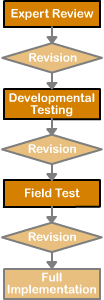
Purpose
Method
Source
To check the validity, relevancy and currency of the materials.

Questionnaires/Interviews that collect data on:

  • Accuracy of the content;
  • Adequacy of examples used;
  • Adequacy of the performance objectives;
  • Comprehensiveness of instructional analysis;
  • Sequencing of content;
  • Appropriateness of material's language, activities, graphics.

Experts in the field who:

  • are highly knowledgeable in the subject area;
  • have not previously been involved in the project (objectivity can be very valuable).
Purpose
Method
Source
To elicit learners' initial reaction to the materials, as well as identify instructional problems (i.e. unclear presentations, confusing instructions, or poor test items). Also, to determine whether or not your assumptions about the learners' entry skills were valid.

Observation: have trainees work independently in a quiet place where you can observe them unobtrusively. Periodically, ask learners to indicate changes they would like to see in the materials.

  • Take extensive notes based on your observations.
  • Calculate the time needed by learners to work through the materials (average time, fastest time and slowest time).
  • Observe learner performance on testing items.
  • Determine learners' attitudes toward the materials - are they motivational? Are they interesting? Are they educational? etc.
A small group of trainees who represent your target audience. Ideally, they will be volunteers who are willing to go through the materials thoroughly and give honest feedback.
To elicit learners' initial reaction to the design/interface and to identify problems related to usability, functionality or aesthetics.

User Acceptance Test (UAT) that test such things as:

  • User background - age, sex, number of hours per day spent using a computer.
  • Perception attitude - tests learners' perceptions/attitudes toward computers and the Internet for learning.
  • Monkey test - allows observer opportunity to record instances of confusion with navigation or e-Learning interactions.
Same as above.
Purpose
Method
Source
To determine if the instructional materials are ready for full implementation.

Trial run that represents actual implementation as closely as possible.

Data collection through questionnaire/interviews to obtain the following:

  • The time it takes each trainee to complete the materials.
  • Learner performance on testing items.
  • Usability, functionality, aesthetics.
  • Experiences of support personnel involved in the training event.
  • Instructors/facilitators, support personnel involved in the training event.
  • Full complement of learners (25-30) accessing the materials in the actual learning environment.