




You've completed the Analysis phase and are now ready to begin the Design
phase. To organize your thinking and help you visualize the e-Learning
creation process, take a look at the following graphic.

In this representation, the Subject Matter Expert (SME) is the person with knowledge of the subject. You are the instructional designer whose role is to take the SME's content and design it into a format that will make sense to learners. The Web Developer role will be discussed in Module 4 of this course, Development.
Notice that the arrow between each role points in both directions. This
is to emphasize that none of the roles occur in isolation. Rather, the
more open the communications are between each player, the better the chances
are that the learning will accurately reflect the SME's knowledge.
The Design phase involves lesson preparation which includes:
- organizing and sequencing your content
- writing proper anticipatory sets and learner objectives
- writing appropriate lesson transitions
- preparing review and/or assessment questions
- preparing learner assignments
The output from the Design phase is in the form of storyboards.
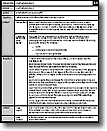
If you think of a building construction analogy, storyboards are to web
developers as blueprints are to contractors (e.g., plumbers, masons, and
electricians). Click the storyboard image to see the actual storyboard
that was used by the web developer to create this lesson. The yellow highlighted
areas you will see in the storyboard are notes written by the instructional
designer to the web developer.
 |
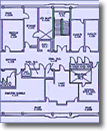 |
| Storyboard | Blueprint |
Prior to storyboarding, you need to answer six questions:
- What are the components and elements of a lesson?
- How much content should each lesson contain?
- What is the proper ratio of text to audio, graphics, and interactivity.
- How are objectives written?
- What is the structure of a storyboard?
- How will you assess the learner's knowledge of the objectives when they have finished the lessons?
These questions are addressed in the remainder of this module.
For further reading on this topic you can access the following
on-line resources: